The PhD in Decision Sciences and Artificial Intelligence (PhD-DSAI) program structure is designed according to international best practices, providing a balanced combination of structured training and independent research (30 ECTS coursework + 210 ECTS research).
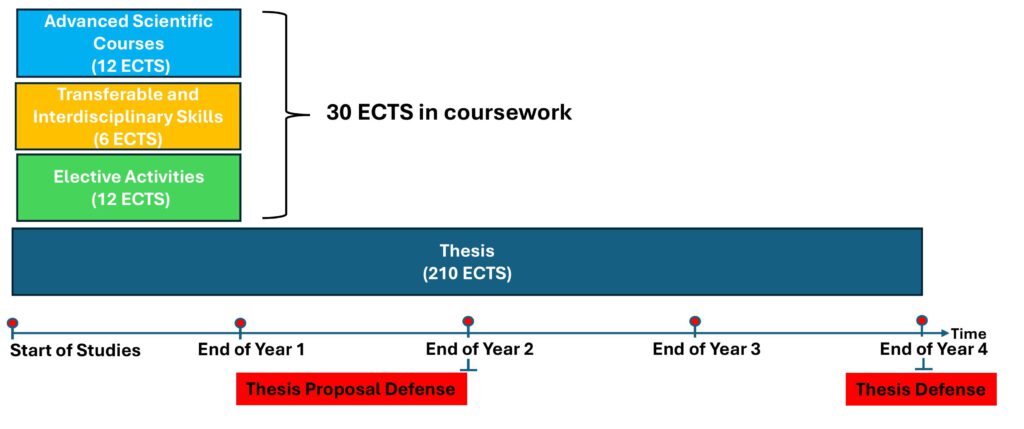
This distribution allows students to acquire essential theoretical foundations and interdisciplinary skills during the first year while dedicating significant time to rigorous, impactful, and internationally competitive research during the subsequent years.
Overview
The PhD programme in Decision Sciences and Artificial Intelligence (DSAI) at Instituto Superior de Engenharia de Lisboa (ISEL/IPL) provides advanced training in optimization, artificial intelligence, data science, and statistical modeling. This innovative and interdisciplinary PhD is designed to equip researchers and professionals with cutting-edge methodologies and practical skills essential to address complex scientific, technological, and societal challenges.
Why Choose the PhD-DSAI?
Interdisciplinary Excellence: Bridging multiple fields, including computer science, engineering, mathematics, and management.
Real-World Impact: Strong connections with industry through strategic partnerships with companies and technology centers, promoting applied research and innovation.
International Collaboration: Active involvement in international networks such as COST Actions, U!REKA, and Erasmus+ programs, providing extensive opportunities for international research mobility.
Customizable Learning Path: Diverse elective courses and specialized tracks allow students to tailor their research interests and career goals.
Programme Structure and Target Audience
Curriculum Structure
The PhD-DSAI program follows internationally recognized best practices in doctoral education, ensuring academic rigor, interdisciplinary collaboration, and strong research-industry connections. The total of 30 ECTS in coursework is structured as follows:
- 12 ECTS in Advanced Scientific Courses
- 6 ECTS in Transferable and Interdisciplinary Skills
- 12 ECTS in Elective Activities, including specialization electives, research internships, or teaching support
The remaining 210 ECTS are dedicated to original research leading to the doctoral dissertation.
Detailed curricular information can be found on the Year 1: Core Curriculum page.
Target Audience
The PhD program in Decision Sciences and Artificial Intelligence is designed for candidates with strong analytical and computational skills interested in tackling complex decision-making problems using optimization, artificial intelligence, and statistical modeling.
Expected Student Profile
- Graduates with a Master’s degree in Mathematics, Engineering, Computer Science, Economics, or related disciplines.
- Professionals seeking to enhance their expertise in AI, optimization, and decision sciences for applications in academia, industry, and research institutions.
- International students interested in a multidisciplinary research environment, with collaboration opportunities in U!REKA, COST Actions, and Erasmus+ programs.
Year 1: Core Curriculum
1st Semester
- CU1: Optimization Methods and Operations Research (6 ECTS)
- CU2: Artificial Intelligence and Machine Learning Fundamentals (6 ECTS)
- CU5: Statistical Learning and Uncertainty Modeling (6 ECTS)
2nd Semester
- CU3: Scalable Data Processing and Artificial Intelligence (3 ECTS)
- CU4: Research Methodology, Scientific Writing and Thesis Preparation (3 ECTS)
- Specialization Areas, select two:
- CU6: Advanced Statistical Modelling (3 ECTS)
- CU7: Algorithm Engineering (3 ECTS)
- CU8: Time Series Forecasting (3 ECTS)
- CU9: Stochastic Optimization (3 ECTS)
- CU10: Applications of Artificial Intelligence and Optimization in Complex Systems (3 ECTS)
- CU11: Electricity Markets (3 ECTS)
- CU12: Precision Medicine and Systems Biology (3 ECTS)
- CU13: Challenges in Natural and Technological Hazards (3 ECTS)
- CU14: Statistical Physics and Complex Models (3 ECTS)
- CU15: Models and Applications in Decision Analysis (3 ECTS)
- CU16: Evolutionary Optimization in Computational Mechanics (3 ECTS)
- CU17: Artificial Intelligence in Manufacturing Processes (3 ECTS)
- CU18: Behavioral Economics and Cognitive Science (3 ECTS)
- CU19: Network and Logistics Optimization (3 ECTS)
Thesis Advisory Committee (CAT)
The Thesis Advisory Committee (CAT) is a mandatory committee constituted within 12 months following the initial enrollment. It ensures structured academic guidance, scientific quality, and adherence to thesis deadlines.
CAT provides continuous specialized feedback and evaluation of research progress, thesis proposals, and the final thesis. Regular meetings (typically biannual) include evaluations and milestone presentations critical for ensuring timely and rigorous academic results.
For detailed information about CAT composition, responsibilities, and evaluation procedures, please refer to our comprehensive guide:
Thesis Advisory Committee .
Research Specialization Area
The PhD program in Decision Sciences and Artificial Intelligence at ISEL–IPL offers doctoral candidates specialized training in a variety of innovative and interdisciplinary areas. Candidates choose from a selection of research tracks designed to align closely with their academic interests, professional goals, and strategic career objectives.
For detailed information, recommended courses, and guidance on selecting your specialization, please visit the dedicated page: